Before a campaign accepts a crypto donation, check state law, verify the donor under FEC rules, and screen the wallet for sanctions or stolen-fund exposure.
Your treasurer just got a wallet address and a promise: five thousand dollars in ETH, no strings attached. The FEC filing deadline is Friday, and nobody on staff has ever screened a donor's wallet before.
Can a political campaign legally accept a crypto donation?
Yes, under federal law, but the rules are older and narrower than most treasurers assume. In 2014 the FEC issued Advisory Opinion 2014-02, letting the nonconnected Make Your Laws PAC accept Bitcoin contributions, capped at $100 per contributor per election. That opinion covered Bitcoin only. Nothing in it extends automatically to Ether, a stablecoin, or any other token, and the Commission has never issued a follow-up ruling that says otherwise.
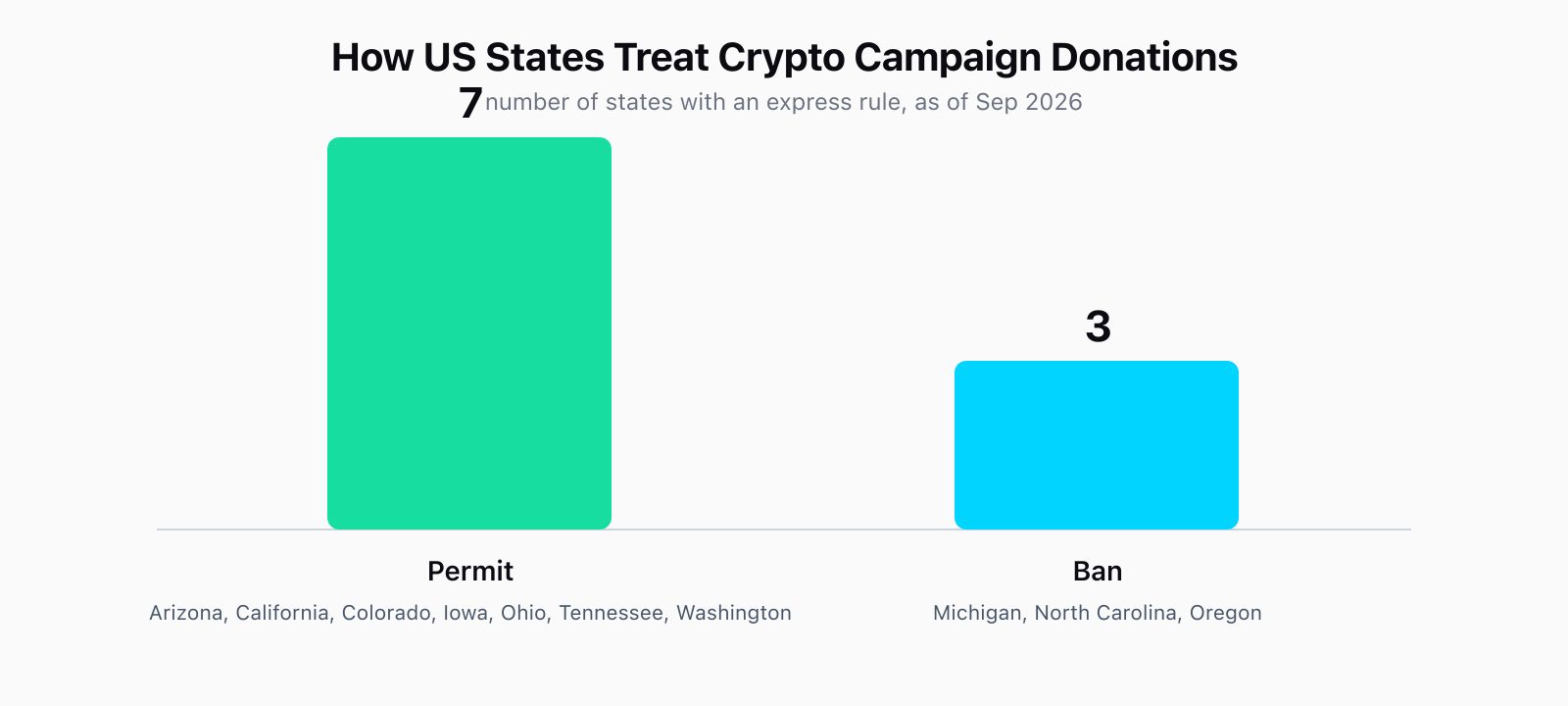
States didn't wait for federal clarity. Arizona, California, Colorado, Iowa, Ohio, Tennessee, and Washington now permit crypto donations under their own election codes, and each wrote its own version of the rule. Michigan, North Carolina, and Oregon ban it outright, citing the coin's price swings as a valuation problem regulators don't want to referee.
Check your state before you check the wallet.
What should you check before you accept the donation?
Run through this list before the funds move, not after.
Confirm your state permits crypto political contributions at all.
Skip Michigan, North Carolina, and Oregon entirely; the donation itself is the violation there.
Collect the donor's legal name, mailing address, employer, and occupation before you hand over a wallet address, exactly as you would for a check.
Get a written affirmation that the donor is a U.S. citizen or lawful permanent resident and isn't fronting the money for someone else.
Screen the wallet address itself for sanctions, mixer, and stolen-fund exposure before you accept it, not after the deposit clears. Screen the donor's address with Plastron for free, in seconds, across seven EVM chains.
Log the date, the coin and amount received, and its fair market value at that exact timestamp, not at the moment you convert it.
Convert to cash inside your state's window. Washington requires same-day conversion; other states follow FEC guidance and value it at the time of receipt instead.
If anything looks wrong, don't spend it. Set the funds aside undeposited and treat the donation the way the FEC treats any questionable contribution: ask for proof, or send it back.
Which states already ban or restrict crypto donations?
The seven permissive states don't agree with each other, let alone with the three that ban the practice. Arizona is the loosest: it treats crypto like ordinary currency and doesn't expressly forbid using it to pay for goods and services. Colorado, Iowa, Ohio, and Tennessee largely track FEC guidance, valuing the contribution at fair market value on the day it lands. Washington is the strictest of the permissive group: a flat $100 cap, mandatory same-day conversion, and no using crypto to buy anything directly.
California banned crypto donations for four years before reversing course in 2022, and now requires campaigns to route contributions through a processor registered with FinCEN. New York joined the permissive column in February 2026, when its Board of Elections ruled that crypto counts as an in-kind contribution, the same treatment the FEC settled on back in 2014.
Seven states have written a permissive crypto-donation rule, three ban it outright, and the permissive states still disagree sharply on caps and conversion timing.
A donation that's routine in Arizona can be a reportable violation in Oregon. Check the state first.
What happens if a sanctioned wallet slips through?
The FEC already has a process for this, and it starts the moment a contribution looks off. A campaign gets ten days to either return an apparently prohibited contribution or set it aside without depositing it. If the funds stay in the account, the campaign then has thirty days to get written proof the money is legal, or refund it.
That clock runs whether or not anyone noticed a problem at intake. A donor address linked to an OFAC-sanctioned entity, a mixer, or stolen funds isn't a reputational footnote, it's the exact fact pattern that thirty-day window exists for. A treasurer who skips the wallet check inherits that clock blind, usually right around the same week campaign finance reports are due.
FAQ
Does the FEC allow cryptocurrencies other than Bitcoin?
The 2014 opinion covered Bitcoin only, and the Commission has never extended the same reasoning to Ether or stablecoins in a published ruling. Treat anything beyond Bitcoin as untested ground and get your own counsel's sign-off before accepting it.
How much can one person donate in crypto to a federal campaign?
The standard federal per-election limit of $2,900 applies to the value of the contribution, but Advisory Opinion 2014-02 specifically capped Bitcoin at $100 per contributor, and several states copied that lower figure straight into their own statutes.
Can a campaign spend crypto directly instead of converting it to cash first?
Federal committees can't; FEC guidance requires liquidation before the funds pay for anything. A handful of permissive states, Arizona among them, allow direct use for goods and services under their own rules.
What if a donor won't provide identity details or a screenable wallet history?
Don't take the donation. The identity fields the FEC requires, name, address, employer, occupation, and a citizenship affirmation, aren't optional paperwork. They're the difference between a lawful contribution and one you're unwinding under the thirty-day rule three months later.
Disclaimer: This article is for educational and informational purposes only and is not legal, financial, tax, or compliance advice. Crypto carries risk; you act on this information at your own risk. Always do your own research and consult a qualified professional before making decisions. Views are the author's own and do not constitute financial, legal, or investment advice.
About Plastron
Plastron is a free, non-custodial wallet screening tool. It checks Ethereum and six EVM chains for AML and KYT risk — sanctions exposure, mixer contact, and stolen-funds proximity — and returns a risk report in seconds. It reads public on-chain data only: it never takes custody of funds and never asks for private keys.