OpenSea and other NFT marketplaces ban wallets tied to OFAC-sanctioned addresses, sometimes within days of a new Treasury designation.
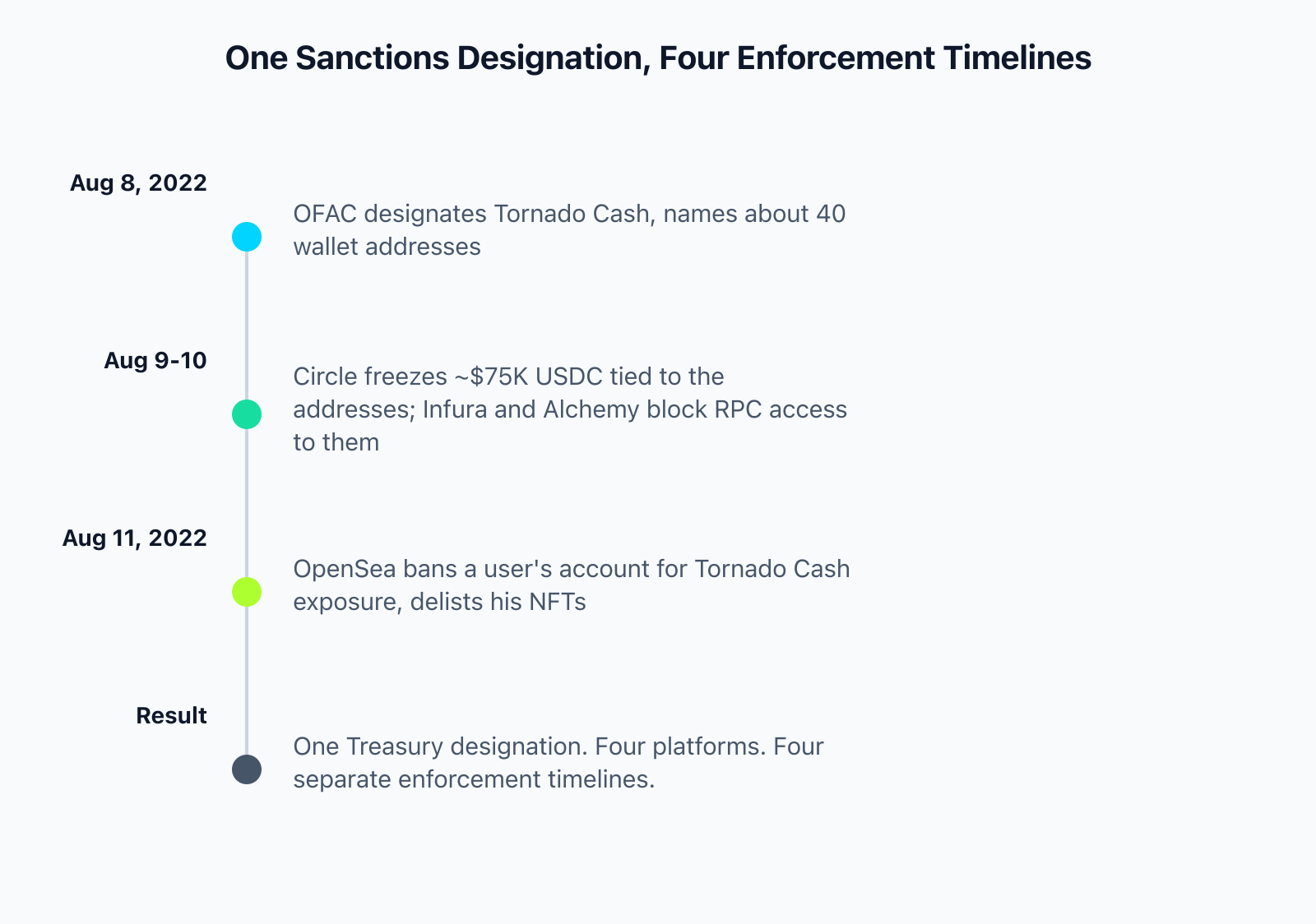
On August 8, 2022, the Treasury's Office of Foreign Assets Control designated Tornado Cash as a specially designated national and named about 40 wallet addresses tied to the mixer. Three days later, an OpenSea user logged in to find his account banned, his NFTs delisted, and no real explanation beyond a line about the terms of service. Most compliance guides talk about centralized exchanges: a Coinbase hold, a Kraken review, a bank freeze after a P2P trade. NFT marketplaces run a version of the same check, and a ban here often comes with no support ticket, no hold period, and no path back.
How OpenSea Enforces Sanctions on Wallets
OpenSea's terms of service prohibit sanctioned individuals, sanctioned jurisdictions, and sanctioned services from using the platform, and the company has enforced that clause more than once. In March 2022 it blocked Iran-based collectors, deactivating verified accounts without warning. In December 2022 it disabled the profile behind the NFTcuba.ART project, drawing accusations that the ban swept up Cuban artists who held other nationalities. Neither case was framed as wallet screening at the time. Both were the same mechanism: match an address or an account against a sanctions list, then cut it off.
The wallet is the identity here. Not the passport, not the IP address, not the name on a KYC form.
One OFAC designation reached four separate platforms within three days, and each enforced it on its own schedule.
Does OpenSea Check Your Wallet Before Every Sale?
Screening isn't a one-time gate you pass at signup. OFAC updates the SDN list on a rolling basis, and a wallet that was clean last week can become sanctioned this week without you doing anything. When the Tornado Cash designation landed, the response wasn't limited to OpenSea. Circle froze roughly $75,000 in USDC tied to the mixer's addresses, and infrastructure providers Alchemy and Infura blocked interactions with the same list within days. A wallet that touched Tornado Cash before August 8 wasn't flagged retroactively everywhere at once - the bans rolled out platform by platform, on each company's own timeline.
You can check a single address against the public SDN list yourself on Etherscan, which flags known-sanctioned addresses on the address page. Screen a wallet's full exposure with Plastron and you get the same sanctions match plus mixer and stolen-funds exposure across chains in one pass, instead of one flag at a time.
What Happens When a Wallet Touches a Sanctioned Address?
OpenSea's ban is binary: an account is either allowed or it isn't. Real risk scoring isn't. Plastron's screening corpus currently tracks 780 OFAC-listed sanctioned addresses across chains, layered against 3,901 labeled risk addresses covering scams, hacks, and mixer activity. A wallet that received a direct deposit from a sanctioned address carries a different risk than one that's three hops removed through an exchange's hot wallet.
A direct deposit from a sanctioned address is not the same risk as a wallet three hops away from one. OpenSea's ban button doesn't know the difference. A graduated risk score does, and that distinction is exactly what decides whether a compliance team unfreezes an account in a day or holds it for a month.
NFT Marketplaces Aren't the Only Web3 Front End Doing This
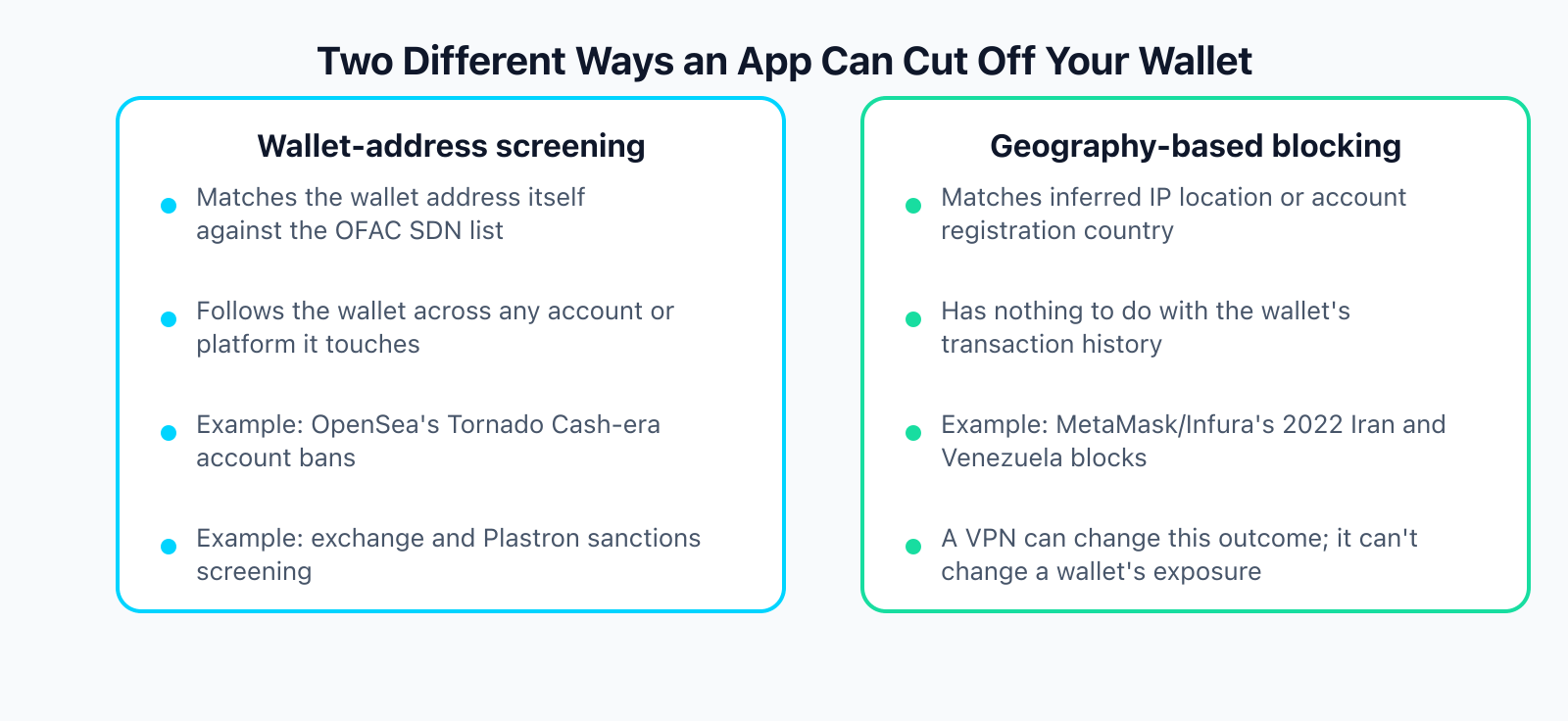
OpenSea isn't unique, and it isn't running the only kind of block. Uniswap's front end screens connecting wallets the same way, refusing service to addresses flagged by its risk vendor before a swap ever reaches the chain. MetaMask and Infura ran a separate, geography-based block in 2022 that briefly cut off users in Venezuela along with sanctioned jurisdictions - a side effect of Infura's own compliance rules, not a wallet-level sanctions match. Both mechanisms can end with the same result: you can't use the app. They start from different triggers, and knowing which one hit you decides what you can actually do about it.
Two different mechanisms can produce the same result: a wallet that suddenly can't use an app.
Can You Get Banned Just for Receiving an NFT You Didn't Ask For?
Yes. Unsolicited transfers count as exposure on most screening systems, and a wallet doesn't get to opt out of what lands in it. An airdropped NFT from a flagged collection, a dust transfer from a sanctioned address, or a gift routed through a mixer can all show up on the same wallet's history a screening tool reads later. Checking whether an address is sanctioned before you connect it to any marketplace or DeFi front end is the only way to know what you're bringing with you.
Screen first. Then connect.
FAQ
Can OpenSea unban a wallet after a sanctions block?
OpenSea doesn't publish an appeals process for sanctions-related bans, and the terms of service treat the prohibition as absolute rather than a hold that expires. Users who believe they were flagged in error have reported reaching support through the terms-of-service contact channel, with no guaranteed outcome or timeline.
Does MetaMask sanction wallets the same way OpenSea does?
Not exactly. MetaMask's 2022 blocks traced back to Infura's regional restrictions, which cut off users by inferred location rather than matching a wallet address against the SDN list. OpenSea's Tornado Cash-era bans were address-based. Both can look identical from the outside - a wallet that suddenly can't use the app.
Is it illegal to buy an NFT with ETH that touched a sanctioned address?
OFAC sanctions attach to the property, not just the person, so receiving sanctioned-linked funds can create liability even without intent. Enforcement in practice has focused on direct dealings with designated entities rather than unknowing recipients several hops removed, but that isn't a legal exemption.
How do I know if my wallet touched a sanctioned address?
Check the address's transaction history against the current OFAC SDN list, including indirect exposure through intermediary wallets, not just direct transfers. A single-address lookup on a block explorer only shows a name-match flag; a full screen shows the hop distance and every category of exposure behind it.
Did the Tornado Cash sanctions ever get reversed?
Yes. OFAC removed Tornado Cash's smart contract addresses from the SDN list in 2025 following a court challenge, though the individual developer sanctions were treated separately. Marketplaces that banned wallets during the 2022-2024 window did not automatically reverse those account-level decisions.
Disclaimer: This article is for educational and informational purposes only and is not legal, financial, tax, or compliance advice. Crypto carries risk; you act on this information at your own risk. Always do your own research and consult a qualified professional before making decisions. Views are the author's own and do not constitute financial, legal, or investment advice.
About Plastron
Plastron is a free, non-custodial wallet screening tool. It checks Ethereum and six EVM chains for AML and KYT risk — sanctions exposure, mixer contact, and stolen-funds proximity — and returns a risk report in seconds. It reads public on-chain data only: it never takes custody of funds and never asks for private keys.