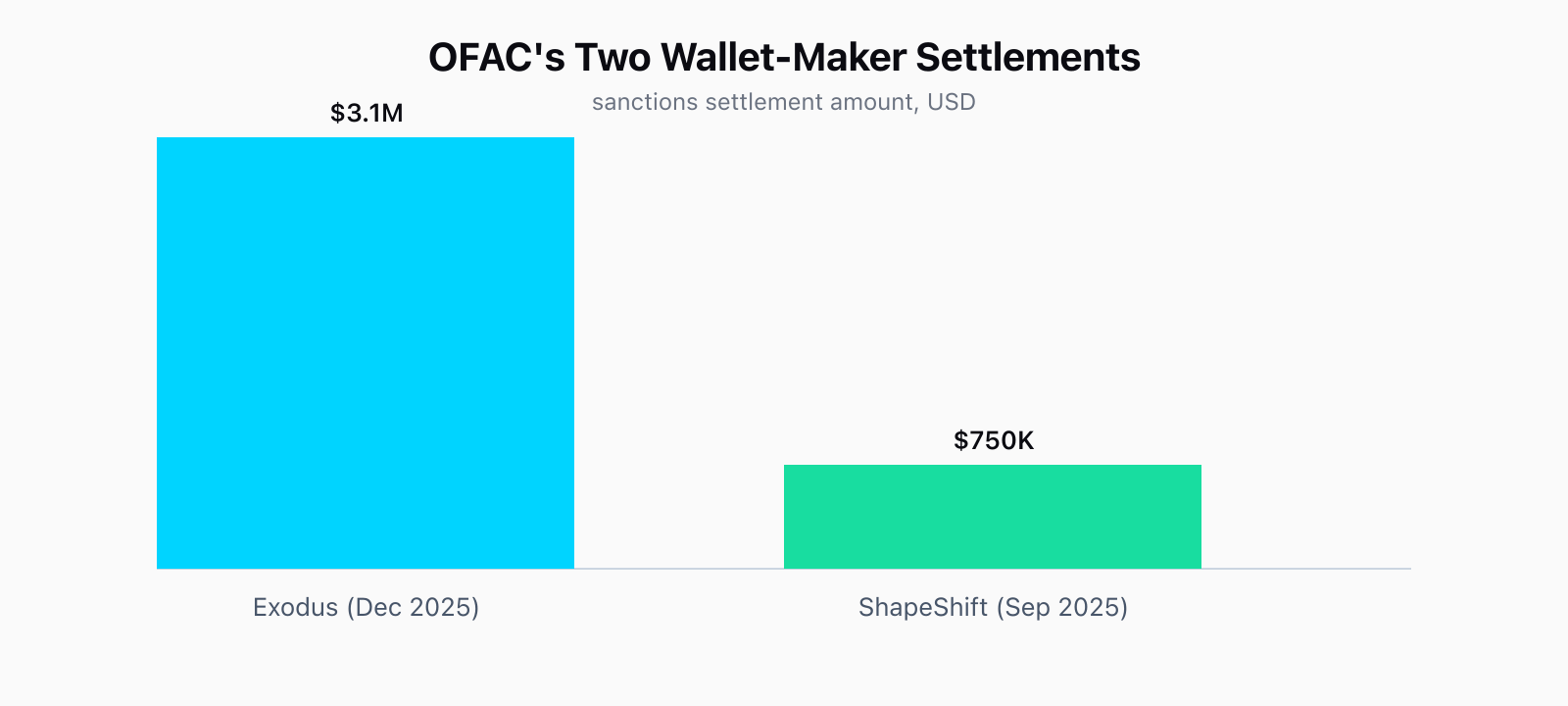
OFAC fined Exodus $3.1 million and ShapeShift $750,000 because being a non-custodial wallet maker never exempted either company from screening users against US sanctions law.
Self-custody was never a compliance exemption. It was a legal theory, and two wallet companies tested it in front of the Treasury Department in 2025 and lost. Most guides to wallet sanctions talk about addresses getting flagged. These two cases are about the software maker getting fined, for building the wallet and never checking who was using it.
What did OFAC actually fine Exodus for?
On December 16, 2025, the Office of Foreign Assets Control announced a $3,103,360 settlement with Exodus Movement, the company behind the Exodus wallet app, over 254 apparent violations of Iran sanctions. OFAC's own release describes Exodus as non-custodial software: the company never held user funds or private keys. That didn't matter.
The violations centered on customer support, not the wallet's code. OFAC found that Exodus staff, in some cases, helped users who identified themselves as being in Iran get connected to digital asset exchanges through the app. OFAC treated 12 of those 254 instances as egregious, and faulted the company for not disclosing any of it voluntarily. The base penalty before mitigation credit was $4,774,400. Exodus also agreed to spend $630,000 on new sanctions controls and to certify its compliance program annually for five years.
One detail makes the case sting more. OFAC noted Exodus had received outside legal advice about its sanctions obligations as early as December 2018, seven years before the settlement. The company knew the exposure existed and kept operating the same way.
Exodus paid more than four times what ShapeShift did, but both settlements rest on the same legal theory: non-custodial status is not a sanctions exemption.
What did ShapeShift do wrong, and how is that different?
ShapeShift's September 2025 settlement is the cleaner case of a pure screening failure. OFAC fined the company $750,000 over 17,183 apparent violations across more than $12.5 million in transactions, all from a window between December 2016 and October 2018. The finding: ShapeShift had no sanctions compliance program at all, and never screened a single wallet address or transaction for a link to a sanctioned jurisdiction, even though it already held IP address data that could have flagged where users were connecting from.
ShapeShift only built a compliance program after receiving an administrative subpoena. By then the company had already shut down the business line the violations came from, which OFAC counted as a mitigating factor alongside its small size and cooperation. The remediation terms read like a checklist Plastron users already get for free: screen new customers, block IP addresses tied to sanctioned jurisdictions, and check every address against an internal blacklist as well as OFAC's own list.
Does "non-custodial" protect a wallet app from sanctions law?
No. OFAC said so directly in the Exodus release: the sanctions obligations applied regardless of the nature of the services Exodus provided, and regardless of whether those services were free. A wallet that never touches user funds can still move a sanctioned person closer to an exchange, a swap, or a counterparty, and that's enough to trigger liability under the same rules that bind a custodial exchange.
DLA Piper's February 2026 analysis of both cases puts it plainly: providing self-custodied wallet software to users in Iran counted as a prohibited export of services under the sanctions regulations. A one-click install screen doesn't change that. Terms of use barring embargoed countries didn't shield Exodus either, OFAC treated that language as necessary but not sufficient on its own.
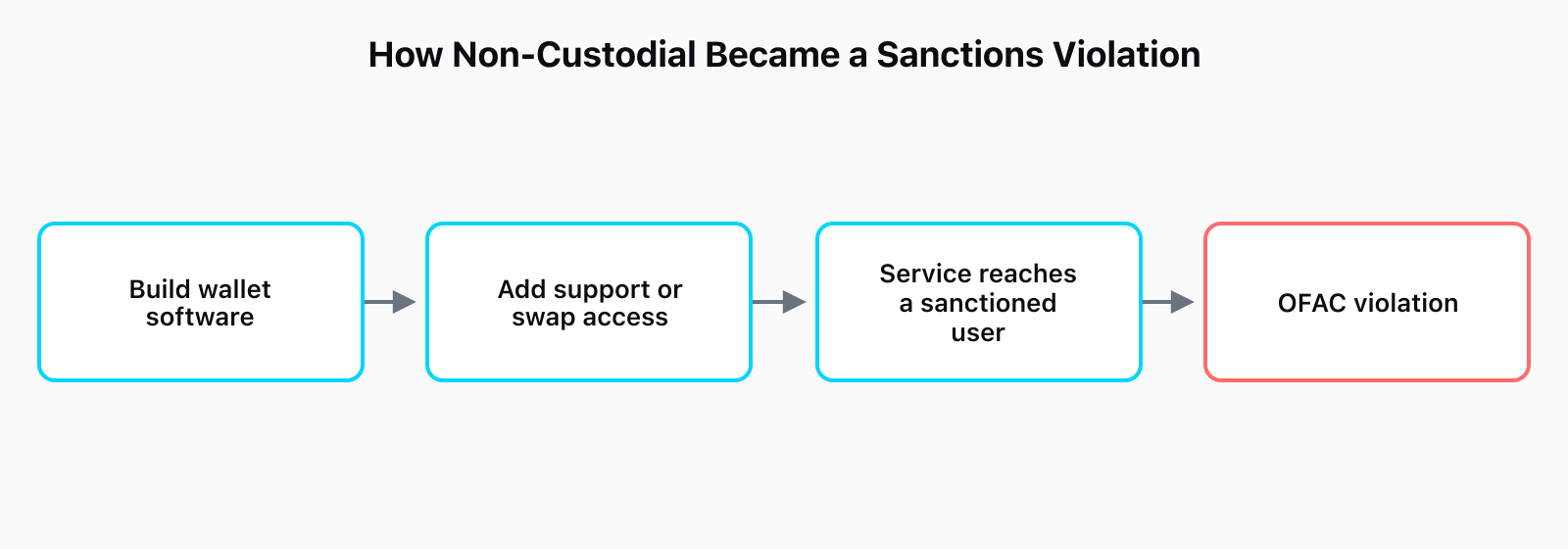
A multisig signer, a DAO contributor, or anyone running a wallet-adjacent service should read both settlements the same way. Building neutral infrastructure stops being neutral the moment you provide support, routing, or a swap feature that a sanctioned user can reach.
Neither company held a single user's funds. Both still crossed into a sanctions violation the moment their service reached a restricted user.
What does this mean if you just use a self-custody wallet?
Nothing about your own liability changed. These settlements punish the companies that built and operated the wallet software, not individual holders for the simple act of downloading an app. But the cases do confirm something worth sitting with: the people who make your wallet are now actively screening for sanctions exposure in ways they weren't five years ago, and that screening is happening at the company level, not on your specific address.
That's a gap. A wallet maker's compliance program protects the company. It does nothing to tell you whether the address about to send you funds, or the one you're about to pay, carries sanctions exposure, mixer contact, or a stolen-funds trail. Etherscan will show you a transaction history, but reading 254 violations' worth of context out of a raw transaction list by hand isn't realistic for anyone outside a compliance team. Screen the wallet with Plastron instead, and the sanctions check, exposure score, and counterparty history come back in one pass, free, before you send anything.
How do you screen a wallet address yourself, right now?
Paste the address. That's the whole first step, on Ethereum or any of six other EVM chains Plastron covers, plus Solana, Tron and Bitcoin as direct-only checks. Plastron's own corpus carries more than 100,000 labeled addresses, plus 1,061 drawn straight from OFAC's SDN list, refreshed as new designations land. None of those labels age out. A sanctioned address from 2019 is exactly as sanctioned today.
Run the check before a deposit lands, not after support asks for a source-of-funds explanation. A direct hit against a sanctions list is free to check on every chain, no account required. Do that first. Everything else in a compliance review follows from what that one check turns up.
FAQ
Does OFAC expect every wallet app to screen addresses?
OFAC's guidance treats sanctions compliance obligations as tied to the services a company provides, not to whether it custodies funds. A wallet that only signs transactions faces a different analysis than one that adds swaps, fiat ramps, or customer support reaching users in sanctioned jurisdictions. The ShapeShift settlement specifically required screening going forward.
Can I get in trouble for using Exodus or ShapeShift?
These settlements target the companies for their own conduct, not users for downloading an app. Risk to an individual comes from transacting directly with a sanctioned address or entity, which is a separate question from which wallet software you run.
What's different between a custodial and non-custodial wallet for sanctions purposes?
Custody determines who holds the keys, not who owes a screening obligation. Both settlements confirm that a non-custodial wallet maker can still be fined for services layered on top, like customer support or unscreened access to exchanges. The custodial vs. non-custodial split still matters for other compliance questions, just not this one.
Is there a free way to check if a crypto address is sanctioned?
Yes. Plastron checks any address against OFAC's SDN list and a wider threat corpus at no cost and with no login, on Ethereum, six other EVM chains, Solana, Tron and Bitcoin.
Disclaimer: This article is for educational and informational purposes only and is not legal, financial, tax, or compliance advice. Crypto carries risk; you act on this information at your own risk. Always do your own research and consult a qualified professional before making decisions. Views are the author's own and do not constitute financial, legal, or investment advice.
About Plastron
Plastron is a free, non-custodial wallet screening tool. It checks Ethereum and six EVM chains for AML and KYT risk — sanctions exposure, mixer contact, and stolen-funds proximity — and returns a risk report in seconds. It reads public on-chain data only: it never takes custody of funds and never asks for private keys.