OFAC rewrote 11 FAQs on October 26, 2026, and the line between a blocked transaction and a rejected one still decides whether your exchange can ever give the funds back.
A blocked wallet and a rejected transaction sound like the same thing. They aren't. The Treasury's Office of Foreign Assets Control amended eleven of its published FAQs on this exact split, plus the reporting rules that follow from it. If you've ever watched a crypto deposit sit in limbo at an exchange with no explanation, this is the regulation sitting behind that decision.
The Difference Between Blocked and Rejected Crypto
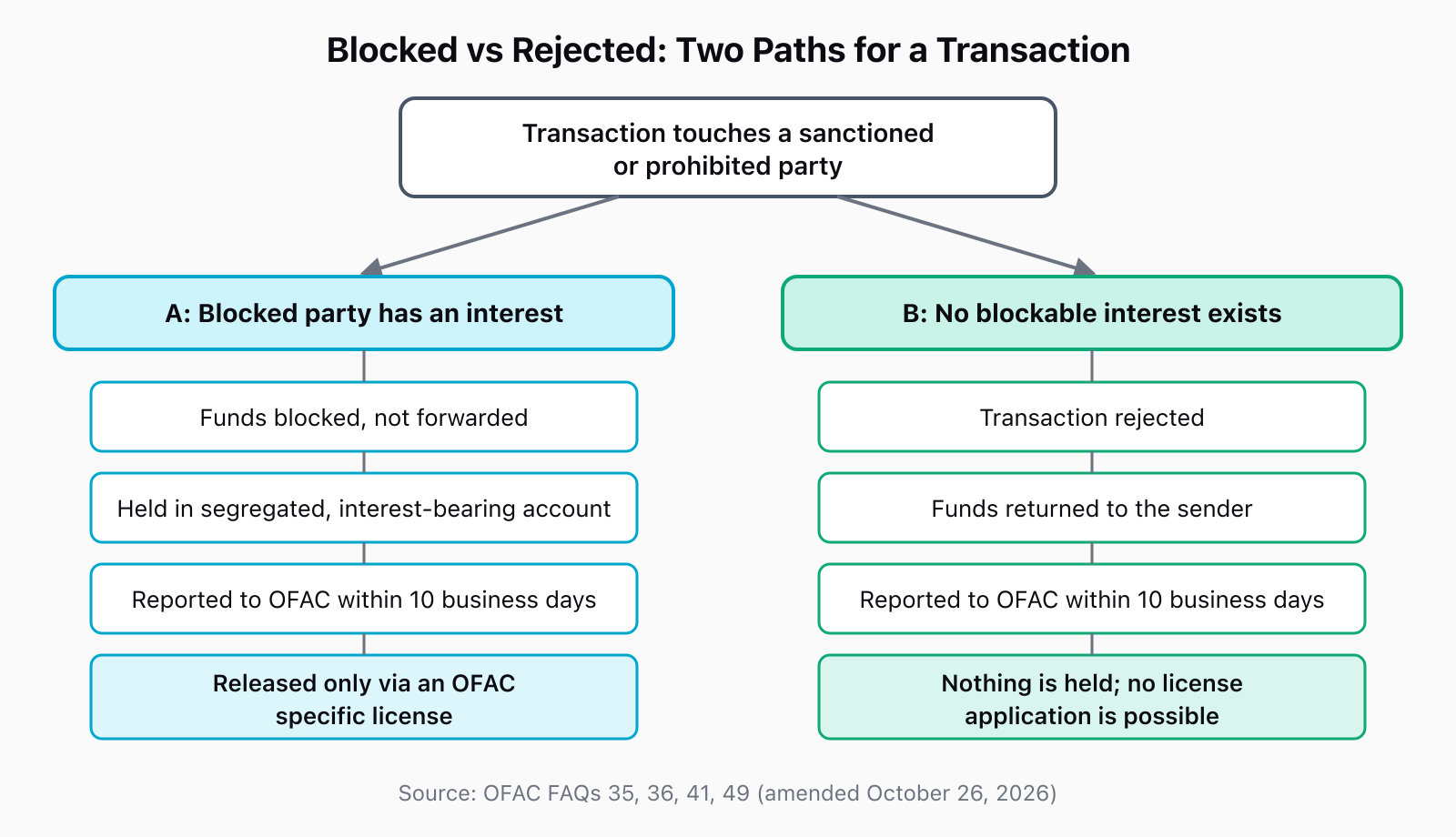
Blocking applies when a sanctioned party has an interest in the funds. The exchange, bank, or other U.S. person has to freeze the property and hold it, not return it. Rejecting applies when the transaction itself is prohibited but no blocked person actually owns the funds, so the transfer gets sent back to wherever it came from instead of being forwarded.
FAQ 36 gives the textbook split: a payment to an Iranian state-owned bank on the SDN list gets blocked, full stop. A payment to a private, non-blocked company in Iran still can't go through, but there's no blockable interest, so it bounces back to the sender as a rejection. FAQ 35 adds a wrinkle most people miss: not every sanctions program even works through blocking. Some only prohibit a category of transaction outright, which means rejection is the only lawful outcome, ever.
Blocking and rejecting end differently: one holds your funds until a license releases them, the other sends them straight back.
Why Did OFAC Update These FAQs Now?
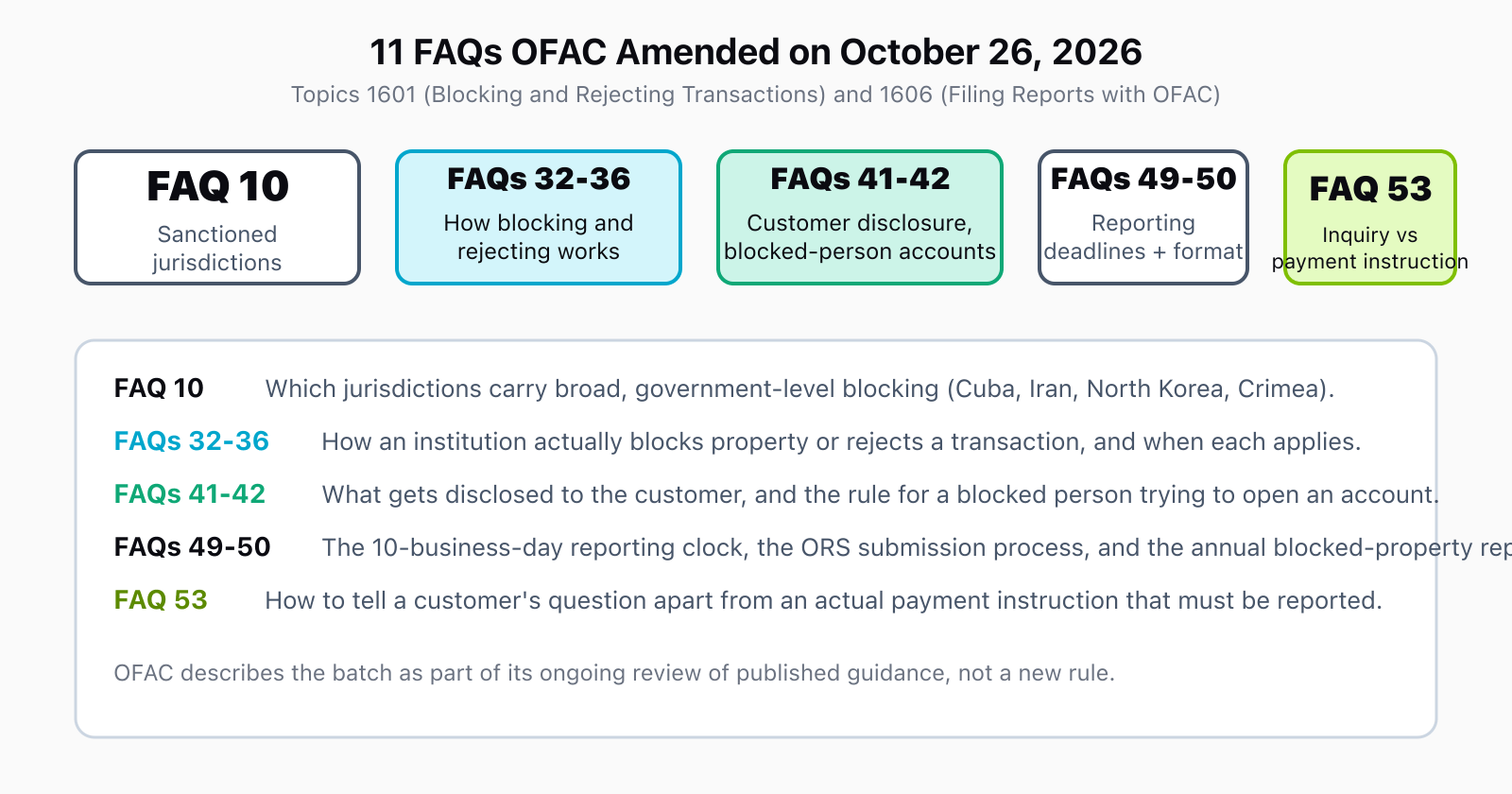
OFAC itself frames the October 26, 2026 batch as routine housekeeping, part of its ongoing review of published guidance to keep the answers current. No new rule shipped with it. The amended FAQs are 10, 32, 33, 34, 35, 36, 41, 42, 49, and 50, plus 53, grouped under two topics: Blocking and Rejecting Transactions, and Filing Reports with OFAC.
FAQ 10 - which jurisdictions carry broad, government-level blocking
FAQs 32-36 - how an institution actually blocks or rejects a transaction
FAQs 41-42 - what gets disclosed to the customer, and what happens if a blocked person tries to open an account
FAQs 49-50 - the reporting mechanics and deadlines
FAQ 53 - telling a customer's question apart from an actual payment instruction
That last one matters more than it looks. A customer asking "can I send crypto to this address" needs no report at all. The same customer submitting an actual transfer to that address triggers blocking or rejection, and the clock starts.
All 11 amendments sort into five groups, and the reporting rules in FAQs 49-50 apply the same way whether the outcome was a block or a rejection.
What Happens When Your Exchange Blocks Your Deposit?
Blocked funds go into a segregated, interest-bearing account under FAQ 32, and FAQ 33 requires the rate to be commercially reasonable, comparable to what any other depositor earns on a similar account. The institution can still deduct normal service charges from that account under FAQ 34, the kind listed in its published fee schedule. None of this is crypto-specific; OFAC wrote these answers for the banking system first, and exchanges inherited them.
FAQ 41 says the institution may tell you property was blocked and name the sanctions program behind it. You can then apply for a specific license to get it released. That's a real process, not a courtesy. Getting a frozen exchange account unfrozen after that kind of review runs on a documented timeline, and the account holder has to start it.
What a Rejected Crypto Transaction Means for You
A rejection sends the funds back where they came from. Nothing gets forwarded, and nothing sits in a segregated account waiting for a license. FAQ 42 covers the related case where a blocked person, an address on the SDN list, tries to open an account or transact with someone who isn't blocked: the institution can't process it, and if blocked property actually lands in its control, it still has to block and report that.
FAQ 42 also flags something worth sitting with: a name match can be a false positive, and OFAC expects it to get verified before anyone treats it as real. Checking whether an address is actually on the SDN list, rather than guessing from a name or a flagged counterparty, is the whole job. Screening the wallet directly with Plastron shows the sanctions, mixer, and stolen-funds exposure in one pass instead of leaving you to cross-reference a government list by hand.
Does Any of This Apply to You as an Individual?
These FAQs bind U.S. persons: banks, exchanges, anyone handling the transaction on the regulated side. They don't reach down and directly regulate an individual crypto holder. But they decide, almost entirely, how your exchange reacts the moment your deposit or withdrawal touches a sanctioned address.
The scale compliance teams are screening against is bigger than most holders assume. Plastron's own corpus carries 1,061 OFAC-sanctioned crypto addresses across 14 chains, inside a broader set of more than 100,000 labeled high-risk wallets built from known scams, hacks, and darknet activity. How a crypto address actually gets onto that SDN list is a separate process from how your bank screens it, and both matter here.
One more thing the FAQs settle: rejected and blocked transactions both carry the same 10-business-day reporting clock to OFAC's Reporting System. A rejection isn't the quiet, no-paperwork outcome some people assume it is.
FAQ
What's the difference between a blocked and a rejected crypto transaction?
Blocked means a sanctioned party has an interest in the funds, so the exchange freezes them and can't return them without a specific license. Rejected means the transfer is prohibited but no blocked person owns the funds, so it bounces back to the sender instead.
How long does my exchange have to report a blocked crypto transaction to OFAC?
Ten business days, through OFAC's Reporting System, under FAQ 49. The same 10-day window applies to a rejected transaction, not just a blocked one.
Will my exchange tell me why it blocked or rejected my transaction?
FAQ 41 permits the institution to disclose that property was blocked and name the sanctions program, though it isn't required to. Some disclosures are even mandated by OFAC in specific cases. A rejection, by contrast, usually just comes back as a failed transfer with no obligation to explain.
Can I earn interest on crypto funds while they're blocked?
FAQ 33 requires blocked funds to earn a commercially reasonable rate, matching other deposits of the same type. OFAC wrote that answer for blocked bank accounts, and most exchanges don't hold frozen crypto in an interest-bearing structure the same way, so check your platform's own terms rather than assuming the bank rule carries over automatically.
What should I do if I think my wallet was blocked by mistake?
Ask the exchange to confirm what triggered the hold, since name-only matches to the SDN list are a known source of false positives under FAQ 42. Verify the actual address against the sanctions list yourself, document the result, and apply for a specific license if the block is genuine but wrongly applied to your funds.
Disclaimer: This article is for educational and informational purposes only and is not legal, financial, tax, or compliance advice. Crypto carries risk; you act on this information at your own risk. Always do your own research and consult a qualified professional before making decisions. Views are the author's own and do not constitute financial, legal, or investment advice.
About Plastron
Plastron is a free, non-custodial wallet screening tool. It checks Ethereum and six EVM chains for AML and KYT risk — sanctions exposure, mixer contact, and stolen-funds proximity — and returns a risk report in seconds. It reads public on-chain data only: it never takes custody of funds and never asks for private keys.