TL;DR - FinCEN withdrew its 2023 crypto mixer rule and 2020 unhosted-wallet proposal on October 5, 2026, but every existing AML obligation, from SAR filing to the Travel Rule, stays exactly where it was.
Withdrawing the mixer rule doesn't make mixer funds clean. It just means FinCEN dropped one specific tool for treating mixing as its own standalone offense category. The two notices landed together on the Federal Register's public inspection site, and most coverage since has collapsed them into one headline: "Treasury drops crypto crackdown." That framing misses who this actually touches. Neither proposal was ever finalized, so a bank, exchange or money services business wakes up October 6, 2026 with the same compliance program it had on October 4. What changed is a future tool Treasury chose not to build, not a present rule anyone was following.
What did FinCEN actually withdraw on October 5, 2026?
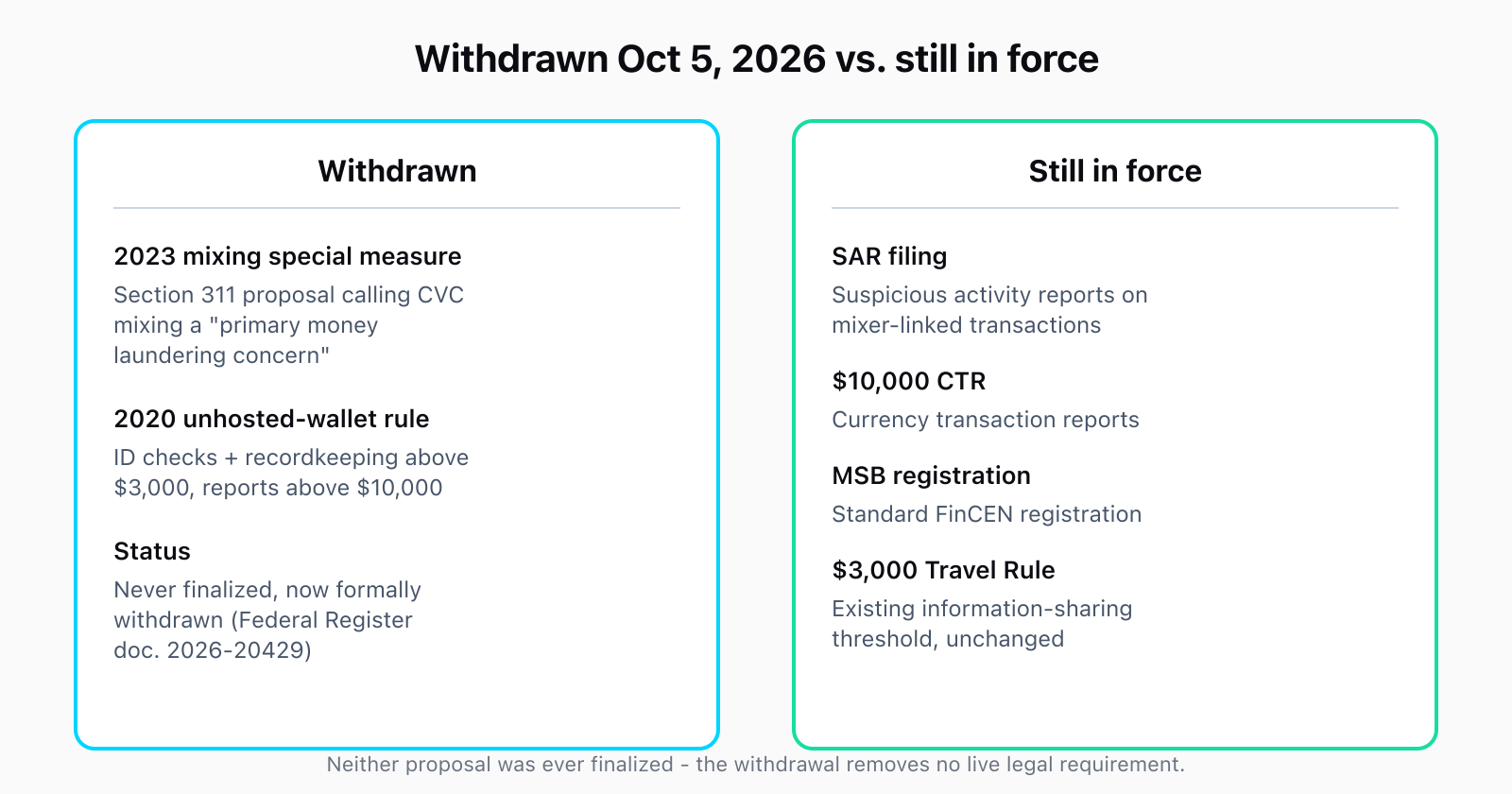
Two separate notices, filed the same day. The first pulls FinCEN's October 2023 finding that international convertible virtual currency mixing is a class of transactions of "primary money laundering concern," along with the Section 311 special measure proposed alongside it. That proposal, published at 88 FR 72701, would have forced banks and money services businesses to report on any transaction touching a mixing service, regardless of the protocol or platform used. The second kills a December 2020 proposal that would have required identity verification and recordkeeping on unhosted-wallet transfers above $3,000, with reports filed above $10,000. The withdrawal notice is document 2026-20429, RIN 1506-AB47, signed by FinCEN Deputy Director Jimmy L. Kirby.
The mixer rule's short, strange life
FinCEN proposed the mixing rule in October 2023 under Section 311 of the USA PATRIOT Act, the same authority Treasury has used against specific foreign banks, never before against an entire category of financial activity. The scope was broad enough to worry people who had nothing to do with laundering. Comment letters argued the definition of "mixing" would sweep in CoinJoin-style wallets, some exchange internal transfers, and privacy features built into mainstream wallets. FinCEN's own withdrawal notice concedes the rule "could have a chilling effect on legitimate activity" and would "place a large reporting burden on covered financial institutions." Three years of comments, zero finalized rule.
Why did FinCEN kill both rules now?
The agency points to its deregulatory mandate under the current administration and what it calls "ongoing efforts to ensure digital asset regulations are fit-for-purpose." It also leans on the July 2025 President's Working Group report, which stated that lawful users of digital assets may use mixers for financial privacy, not just to hide theft. That's a real shift from 2023, when FinCEN treated mixing almost as a presumption of guilt. FinCEN hasn't reversed its underlying view that mixers get abused, though. The same notice says the agency "will continue to monitor activity involving CVC mixers," which reads less like a retreat and more like a decision to fight this battle without a blanket rule.
What still applies to every crypto business
Nothing here touches the obligations that were already in force before either proposal existed. A money services business still has to:
File a Suspicious Activity Report on transactions that look like layering through a mixer or shell wallet
File a Currency Transaction Report on cash-equivalent transactions above $10,000
Register with FinCEN as an MSB if it moves value for other people
Apply the existing $3,000 Travel Rule threshold for sharing sender and recipient information
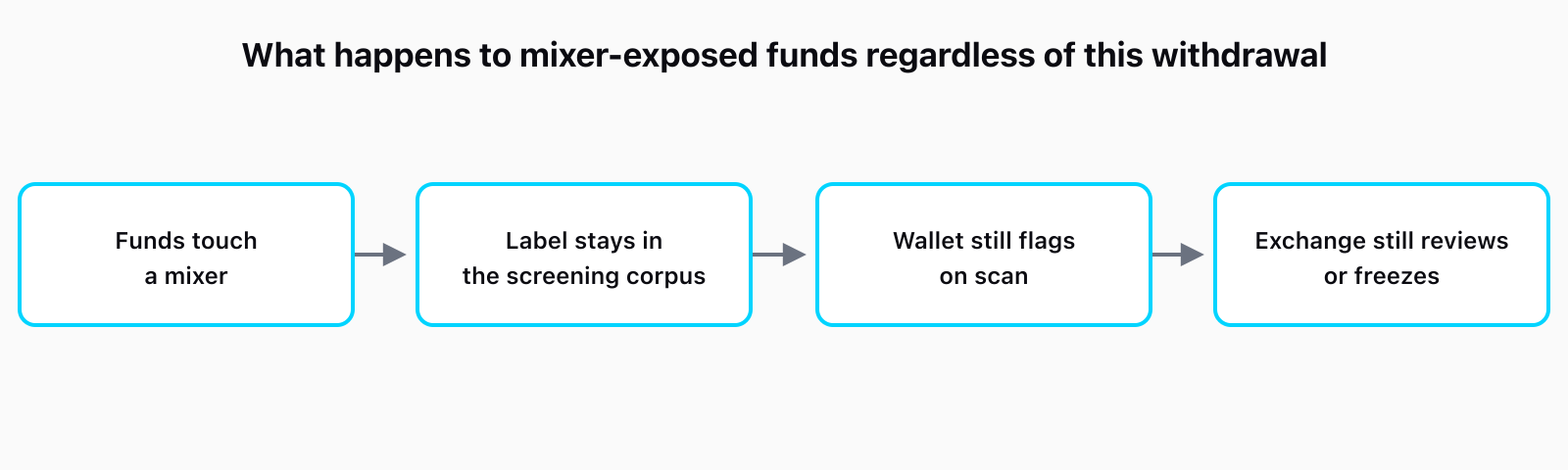
Plastron's own committed screening corpus carries 27 addresses tagged directly as mixer services, sitting inside a larger set of 3,907 labeled addresses and 780 OFAC SDN entries. None of those labels moved when the rule did. A wallet that received funds through Tornado Cash in 2023 is exactly as exposed today as it was last week. Checking that manually means pulling a transaction history off a block explorer and tracing hops by hand, which tells you where funds moved but nothing about whether they touched a sanctioned entity or a flagged mixer. Screen the wallet with Plastron instead, and the mixer and sanctions exposure show up as a scored result, not a guess.
Does this mean mixer funds are safe to accept now?
No. A wallet with mixer exposure is not safer because FinCEN pulled one proposed rule. It's exactly as risky as it was in September. The clearest proof sits in a federal courtroom: Tornado Cash co-founder Roman Storm was convicted in August 2025 on one count of running an unlicensed money transmitting business, and his retrial on the remaining money-laundering and sanctions counts is now scheduled for April 26, 2027. That prosecution never depended on the mixing rule FinCEN just withdrew. It ran on existing money-transmission law, the same law that still applies to anyone operating or knowingly routing funds through a mixing service today.
Four steps happen whether or not the mixer rule exists, because none of them were ever created by that rule in the first place.Two proposals are gone, but SAR filing, CTR reporting, MSB registration and the Travel Rule threshold never depended on either one.
FAQ
Does the FinCEN withdrawal make crypto mixers legal?
Using a mixer was never illegal on its own, and this withdrawal doesn't change that. What hasn't changed either is the legal risk of operating one or knowingly routing laundered funds through one, which Roman Storm's ongoing prosecution shows is still being enforced under existing law.
What happened to the $3,000 unhosted-wallet reporting threshold?
The December 2020 proposal that would have added identity checks above $3,000 and reports above $10,000 for unhosted-wallet transfers is withdrawn. It was never finalized, so no bank or MSB was ever required to follow it.
Do crypto exchanges still have to file SARs on mixer activity?
Yes. Suspicious Activity Report obligations come from the Bank Secrecy Act, not from the withdrawn mixing rule, and apply regardless of this notice.
Is this related to the Tornado Cash case against Roman Storm?
Not directly. Storm's conviction rests on unlicensed money transmission, a charge that predates and doesn't depend on FinCEN's 2023 mixing proposal.
Why did FinCEN withdraw the unhosted-wallet rule alongside the mixer rule?
Both notices were filed the same day as part of what FinCEN called ongoing efforts to make digital asset rules fit-for-purpose. Neither proposal had been finalized in the years since it was first proposed.
Disclaimer: This article is for educational and informational purposes only and is not legal, financial, tax, or compliance advice. Crypto carries risk; you act on this information at your own risk. Always do your own research and consult a qualified professional before making decisions. Views are the author's own and do not constitute financial, legal, or investment advice.
About Plastron
Plastron is a free, non-custodial wallet screening tool. It checks Ethereum and six EVM chains for AML and KYT risk — sanctions exposure, mixer contact, and stolen-funds proximity — and returns a risk report in seconds. It reads public on-chain data only: it never takes custody of funds and never asks for private keys.