A fully compliant exchange can still block your crypto transfer because the Travel Rule rolled out on different timelines worldwide, leaving one side legally required to send data the other side has no way to receive.
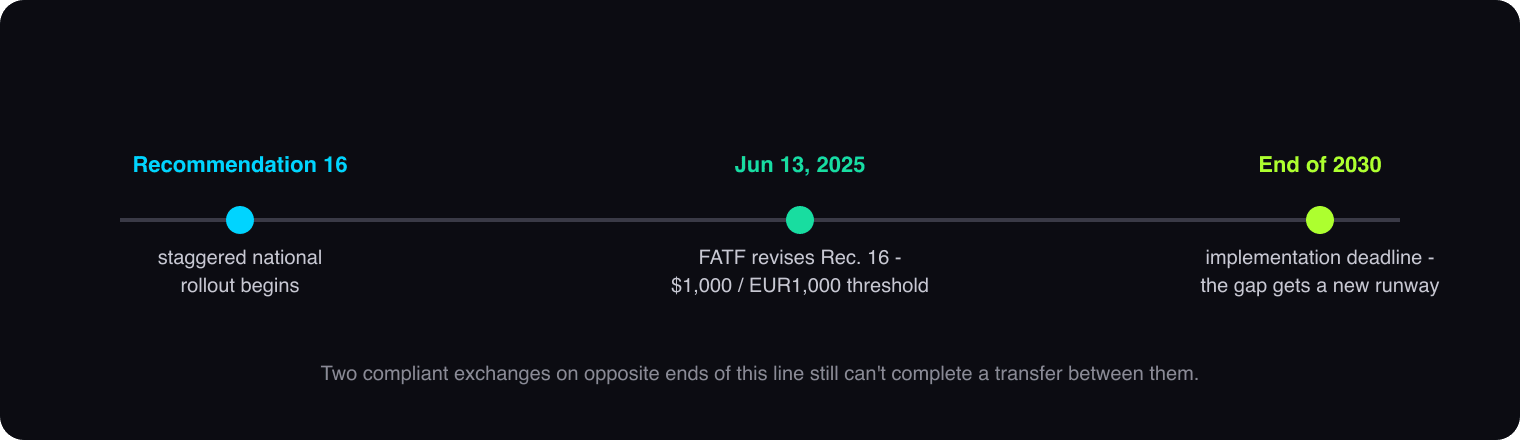
On June 13, 2025, FATF adopted a revised Travel Rule and gave every jurisdiction until the end of 2030 to finish rolling it out. That five-year runway all but guarantees two compliant exchanges will keep hitting a wall neither one built: a counterparty that is legally required to receive Travel Rule data but isn't ready to process it yet. Most explainers treat the Travel Rule as one global switch. It isn't. Different countries turned it on at different times, and a transfer caught between two of those timelines doesn't get canceled. It stalls.
The Sunrise Issue Is a Timing Gap, Not a Compliance Failure
Compliance teams call this the sunrise issue. The metaphor comes from the way sunrise happens at different times around the world, so "daytime" obligations exist in some jurisdictions while it's still "night" in others. The requirement itself is not complicated: a bank wire carries a name and address, and FATF's Recommendation 16 asks a Virtual Asset Service Provider to attach the same originator and beneficiary details above a set threshold. What breaks down is the other side. Not every VASP receiving that transfer is required, or even able, to process the data yet.
A 2023 industry survey by Notabene found more than a third of VASPs, 34.8%, weren't complying with the Travel Rule at all, and 7.8% went further - they block a transfer outright rather than send it without a compliance message attached.
FATF's own 2025 revision runs to the end of 2030 - the sunrise gap between fast and slow jurisdictions isn't closing this decade.
Why Does a Fully Compliant Exchange Still Block Your Transfer?
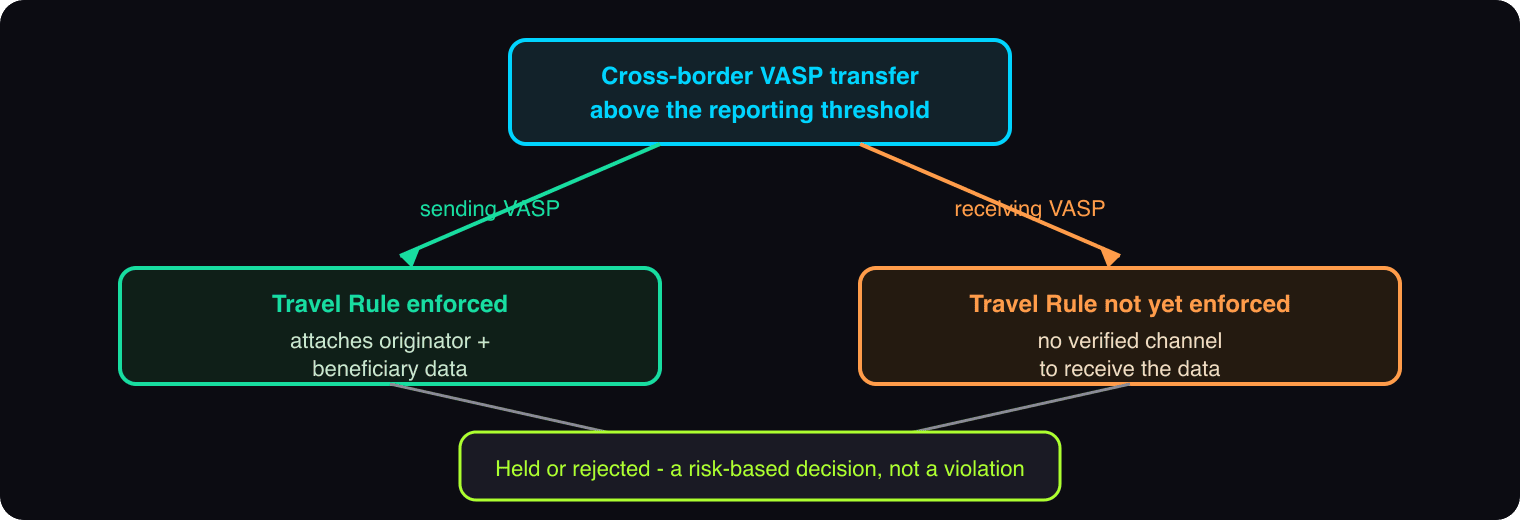
Because sending the data isn't the same as landing it. Picture two exchanges: one in a jurisdiction that enforced the Travel Rule years ago, one where the local regulator hasn't finished drafting guidance. The first exchange must attach your name and wallet details before it releases funds. The second has no verified channel to receive that message, no obligation yet to check it, and often no staff trained to act on it if it arrives. Faced with that gap, a risk-based compliance program does the cautious thing: it holds the transfer, asks for extra verification, or refuses the destination outright.
Notabene's same survey put 41.2% of VASPs in that risk-based camp, reviewing transfers case by case instead of blocking or waving everything through. Your hold is very likely one of those case-by-case reviews, not a red flag on your account.
Both sides can be fully compliant with their own rules and still produce a held transfer - the mismatch sits between the two timelines, not inside either program.
FATF's 2025 Update Extended the Runway, Not the Deadline
The June 13, 2025 revision was the first real update to Recommendation 16 since the Travel Rule began. It lets countries set a de minimis threshold as low as $1,000 or EUR1,000, adds fraud to the list of offenses the rule targets, and calls for enhanced originator and beneficiary information formatted for systems like ISO 20022. None of that closes the sunrise gap. Financial institutions now have until the end of 2030 to finish implementing the revised standard, so the distance between fast-moving and slow-moving jurisdictions just got a new five-year lease on life.
The Same Gap Creates a Sanctions Screening Blind Spot
Missing counterparty data doesn't just delay a transfer. It also means the receiving VASP can't run the sender's identity against a sanctions list the way it normally would, because the identity never arrived. A destination address with no Travel Rule message forces a compliance team back onto whatever the chain itself can show them. Plastron's own dataset currently tags 3,901 labeled addresses across scam, mixer, and sanctions-linked clusters, checked daily against 780 entries on the OFAC SDN list - built for exactly this gap, when the paperwork isn't there and the wallet has to speak for itself. A block explorer like Etherscan shows raw transaction history, but spotting a sanctioned or scam-linked cluster by eye takes more than a glance. Screen the wallet with Plastron instead and you get a direct read on exposure in seconds, no Travel Rule message required.
Can You Do Anything About a Stalled Travel Rule Transfer?
Contact your exchange's support team and ask specifically whether the hold is a Travel Rule compliance issue - that phrase routes the ticket differently than a generic "under review" complaint. Ask whether the destination VASP is listed as Travel Rule-ready; several vendors, including Notabene, publish compliance status by exchange. If you're sending funds to a self-hosted wallet instead of another VASP, the rule works differently again - our explainer on self-custody and the Travel Rule covers where that threshold sits. And if the delay runs past a few days with no update, ask for a written explanation. An indefinite hold with no reason given is itself a red flag under most AML programs - for the exchange, not for you.
FAQ
What is the Travel Rule sunrise issue?
It's the gap created because countries enforce the crypto Travel Rule - the requirement to attach originator and beneficiary data to transfers above a threshold - on different timelines. A compliant exchange in an early-adopting country can end up sending data to a VASP whose home jurisdiction hasn't required, or enabled, it to receive that data yet.
Does the sunrise issue mean my exchange broke the law?
No. Both sides can be fully compliant with their own jurisdiction's rules and still be unable to complete a Travel Rule transfer with each other. The hold you're seeing is usually a risk-based compliance decision, not evidence either exchange did something wrong.
When will the sunrise issue go away?
Not soon. FATF's June 2025 revision to Recommendation 16 gives jurisdictions until the end of 2030 to finish implementing the updated standard, and earlier rounds of the same rule already took years longer than FATF originally planned.
Which crypto transfers are affected?
Only transfers between VASPs - exchanges, custodians, and other regulated platforms - above the jurisdiction's reporting threshold, which the 2025 update lets regulators set as low as $1,000 or EUR1,000. A transfer to a self-hosted wallet falls under different rules depending on the receiving country, covered in our EU self-hosted wallet threshold explainer.
Disclaimer: This article is for educational and informational purposes only and is not legal, financial, tax, or compliance advice. Crypto carries risk; you act on this information at your own risk. Always do your own research and consult a qualified professional before making decisions. Views are the author's own and do not constitute financial, legal, or investment advice.
About Plastron
Plastron is a free, non-custodial wallet screening tool. It checks Ethereum and six EVM chains for AML and KYT risk — sanctions exposure, mixer contact, and stolen-funds proximity — and returns a risk report in seconds. It reads public on-chain data only: it never takes custody of funds and never asks for private keys.