Yes - OFAC can sanction an entire exchange, and BitBank's September 2026 designation shows exactly what that does and doesn't freeze.
On September 17, 2026, Treasury's Office of Foreign Assets Control put BitBank, an Iranian digital-asset exchange, on the SDN list along with its developer and three of its executives. The designation names Babak Zanjani, an Iranian financier Treasury had already sanctioned in January, as the person controlling BitBank. Treasury says the exchange moved hundreds of millions of dollars' worth of Bitcoin to the IRGC, Iran's paramilitary Guard Corps, between June and July 2026, funneled through a Hormuz Strait ship-toll operator that had also been designated.
Most coverage of the BitBank case stopped at the press release. It skipped the part that actually matters to anyone who's ever moved funds through an exchange with ties to a sanctioned jurisdiction: what "sanctioning an exchange" changes on the ground, and what it doesn't.
OFAC Can Block a Whole Company, Not Just an Address
An OFAC designation attaches to a legal person - a company, its owners, its officers - not to a single wallet. Once BitBank landed on the SDN list, every asset it holds in U.S. jurisdiction, or that passes through a U.S. financial institution, gets blocked by operation of law. No court order and no separate wallet-level listing is required.
Treasury used Executive Order 13902 to do it. That order lets OFAC sanction Iran's digital-asset sector the same way it already sanctions Iran's construction and mining sectors, without proving a direct terrorism link for each transaction. The developer entity, Pishtaz Simorgh Electronic Trade Company, and three named associates - Hossein Ali Zaker Hossein, Mohammad Mahdi Zaker Hossein, and Seyed Adel Heidari - went down with it under the same order.
Is This the First Time an Exchange Got Sanctioned Whole?
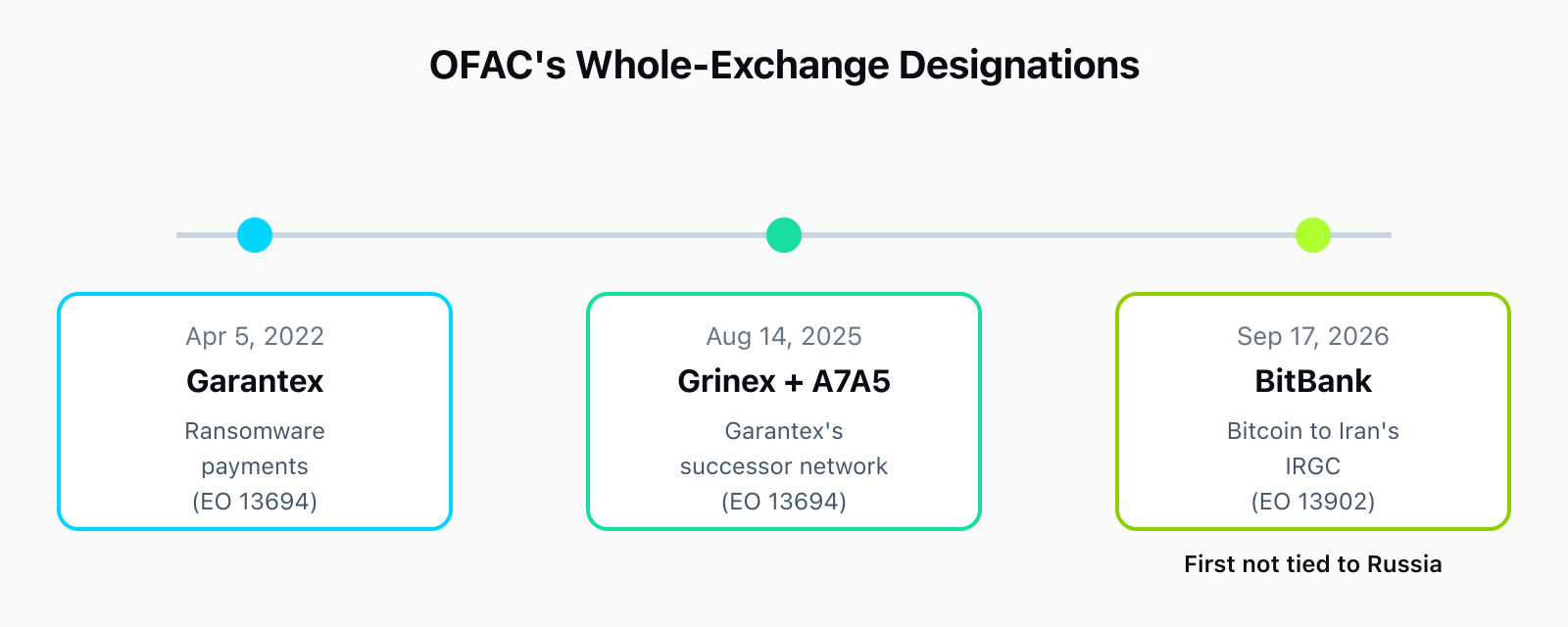
No. Garantex was the first crypto exchange OFAC put on the SDN list outright, on April 5, 2022, over ransomware payments it processed. When Garantex's operators resurfaced as Grinex, OFAC sanctioned that successor too, on August 14, 2025, along with the A7A5 stablecoin network built to keep the money moving. BitBank is the same playbook, third time, aimed at Iran instead of Russia.
BitBank is OFAC's third full-exchange SDN designation in four years, and the first built on Iran sanctions rather than the Russia-focused cyber order.
Not every exchange takedown runs through OFAC, either. Bitzlato was shut down in January 2023 through a FinCEN order under Section 9714, a different tool that bars U.S. banks from touching the exchange's funds without putting it on the SDN list at all. The label changes; the practical effect on a former customer's money is close to identical.
What Happens to Money Still Sitting Inside BitBank
It stays frozen. Any BitBank asset a U.S. person or U.S.-linked institution holds or processes has to be blocked and reported to OFAC, and it stays blocked until OFAC issues a specific license authorizing release. There's no appeal window and no automatic unwind. The Treasury notice on BitBank didn't publish individual wallet addresses the way some designations do, which means the block operates at the entity level - through BitBank's accounts and counterparties - rather than through a list of tainted addresses a screening tool can match directly.
That's a meaningful gap for anyone trying to check their own exposure right now. A wallet that only ever touched BitBank through an intermediary won't show up against any published address list, because none exists yet for this designation.
Does This Reach a Wallet That Never Touched BitBank?
Sometimes. OFAC's 50 percent rule blocks any company that a sanctioned person owns 50 percent or more of, even if that company was never separately named - which is why Pishtaz Simorgh and BitBank's three executives went down in the same notice as Zanjani himself. A wallet gets pulled into that same exposure if it dealt with any of those linked entities, not just the exchange's own brand name.
Checking that by hand means cross-referencing a wallet's transaction history against every entity in the designation, plus Iran's existing 97 previously listed Ethereum-side SDN addresses and the roughly 513 Bitcoin addresses OFAC has designated to date - the exact kind of lookup a block explorer shows one transaction at a time. Running the address through Plastron checks it against the full OFAC SDN list and more than 3,900 labeled high-risk addresses in one pass. On Bitcoin, that check is direct-only for now - sanctions and known-threat matching plus balance and activity, without the multi-hop counterparty tracing Plastron runs on Ethereum, so a clean Bitcoin result carries less weight than a clean Ethereum one.
FAQ
Did OFAC publish specific BitBank wallet addresses?
No. The September 17, 2026 notice designates BitBank, its developer, and three individuals, but Treasury's release doesn't list wallet addresses - it points to OFAC's recent-actions page for any blocked property identified later.
What is Executive Order 13902?
It's the 2020 order that lets OFAC sanction Iran's construction, mining, manufacturing, and textile sectors, expanded here to cover digital assets, so Treasury doesn't need a separate terrorism finding for every transaction it targets.
Can a former BitBank customer get frozen funds released?
Only through a specific license from OFAC. There's no automatic release date, and moving blocked funds without one is itself a violation, regardless of when the customer's deposit predates the designation.
Does OFAC's 50 percent rule apply here?
Yes - any entity Babak Zanjani or BitBank owns 50 percent or more of is blocked automatically, which is why the developer company and three executives were named in the same action instead of a follow-up designation.
Disclaimer: This article is for educational and informational purposes only and is not legal, financial, tax, or compliance advice. Crypto carries risk; you act on this information at your own risk. Always do your own research and consult a qualified professional before making decisions. Views are the author's own and do not constitute financial, legal, or investment advice.
About Plastron
Plastron is a free, non-custodial wallet screening tool. It checks Ethereum and six EVM chains for AML and KYT risk — sanctions exposure, mixer contact, and stolen-funds proximity — and returns a risk report in seconds. It reads public on-chain data only: it never takes custody of funds and never asks for private keys.